As election season approaches, conversations across Arizona are heating up around the economy, growth, public safety, and infrastructure. But here in rural Arizona, especially in La Paz County, one issue quietly shapes nearly all of them: water.
Water affects our communities, our health, our agriculture, our housing, our businesses, and the future sustainability of the places we call home. While many voters understandably focus on national politics during election years, local and state elections often have the greatest impact on water policy decisions that directly affect our daily lives.
This article is not intended to support or oppose any candidate or political party. Instead, it is an invitation for residents to think critically about water when evaluating candidates for office and to better understand how elected officials influence water policy in Arizona.
Why State Elections Matter for Water
Arizona’s legislators vote on laws that shape groundwater management, infrastructure funding, conservation programs, development regulations, rural protections, and water transfer policies. These decisions can have long-term consequences for both urban and rural communities.
In recent years, Arizona has seen increasing public concern around topics such as:
- Groundwater depletion in rural basins
- Large-scale agricultural water use
- Water transportation and transfer proposals
- Data center and industrial water demand
- Housing and growth pressures
- Drought and Colorado River shortages
- Rural access to reliable drinking water
Many of these issues are debated and decided through state legislation.
Even if a bill does not directly mention La Paz County, the outcomes can still influence how water is managed, monitored, protected, or allocated in our region.
Water Is Not a Partisan Issue
People from across the political spectrum care deeply about water. Rural conservatives, tribal communities, environmental advocates, ranchers, farmers, business owners, retirees, and new residents may disagree on many things but nearly everyone agrees that water security matters.
The challenge is that water policy is often complex, technical, and difficult to summarize in campaign slogans.
Candidates may talk broadly about “protecting Arizona water” without explaining:
- What policies they support
- How they balance competing interests
- Whether they support stronger groundwater protections
- How they view rural versus urban priorities
- What role conservation should play
- How they approach growth and development
That is why voters benefit from asking thoughtful questions and looking beyond simple talking points.
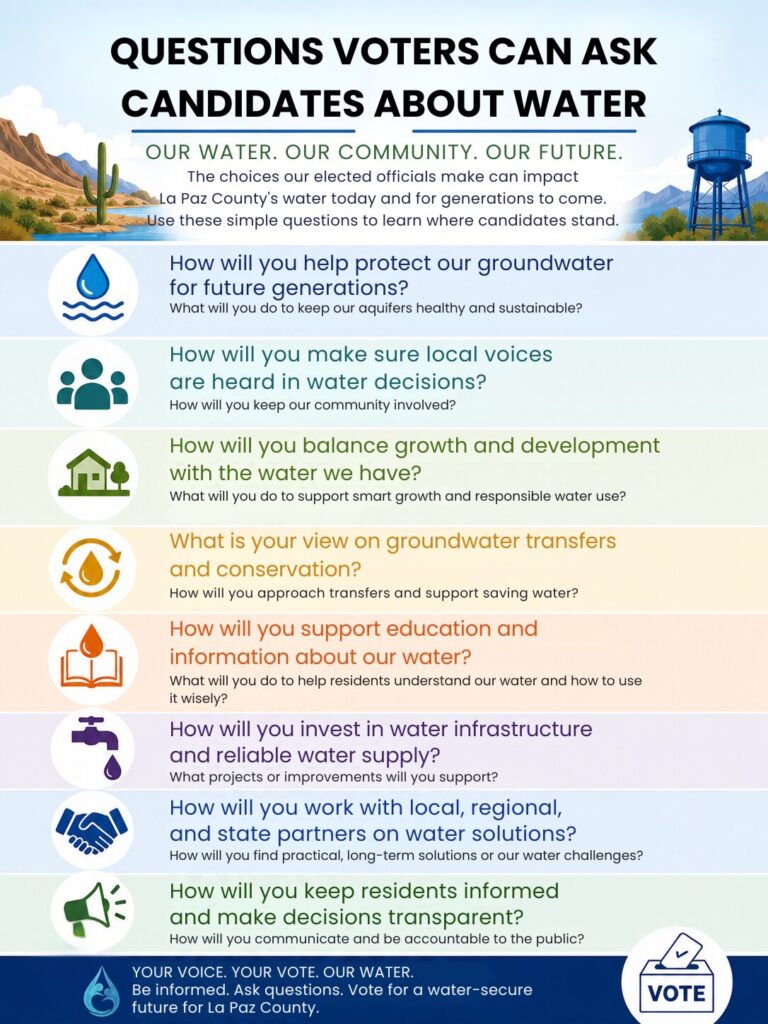
Questions Voters Can Ask Candidates
Residents do not need to be water experts to ask meaningful questions. Here are a few examples voters may consider:
- What is your position on rural groundwater protections?
- How should Arizona balance economic growth with long-term water sustainability?
- Do you support local communities having a stronger voice in water decisions?
- How do you think Arizona should address areas experiencing groundwater decline?
- What role do you think conservation and efficiency play in future water planning?
- How should the state support small rural communities with aging water infrastructure?
- How do you evaluate proposals involving large industrial or agricultural water use?
- What steps should Arizona take to prepare for long-term drought conditions?
Equally important is how candidates answer these questions. Are they specific? Do they demonstrate understanding of the issue? Do they acknowledge tradeoffs and complexity? Are they willing to engage respectfully with differing viewpoints?
Looking for non-partisan voting and candidate information? Check out https://www.vote411.org/
Looking Beyond Political Labels
Water policy does not always divide neatly along partisan lines.
Some candidates may prioritize economic development and property rights. Others may emphasize conservation, regulation, or long-term sustainability planning. Many attempt to balance all of these priorities simultaneously.
Voters may find it useful to:
- Review voting records when available
- Attend local forums or town halls
- Read candidate websites carefully
- Watch how candidates discuss rural communities
- Pay attention to whether they rely on facts, fear, or oversimplification
Water policy is rarely simple, and honest conversations about it should reflect that reality.
Why Community Engagement Matters
One of the most important things residents can do is stay engaged before and after elections.
Water policy decisions often happen through:
- Legislative committees
- Public hearings
- State agency processes
- County planning discussions
- Community meetings
- Regulatory comment periods
An informed and engaged public helps ensure that rural voices are heard.
Participating respectfully in conversations about water helps strengthen local decision-making and community resilience.
Our Shared Future
Water connects all of us. It affects longtime residents, newcomers, businesses, agriculture, tourism, wildlife, and future generations alike.
Elections matter because the people we send to represent us help shape the policies that determine how Arizona manages one of its most essential and limited resources.
As voters evaluate candidates this election season, water deserves a place in the conversation.
Click the image below to Download a PDF version