Artificial intelligence is rapidly changing the world around us. AI systems require enormous computing power to perform online searches, run business operations, and scientific research and that computing power lives inside massive data centers.
Across Arizona, conversations are growing about what this new wave of development could mean for water, energy, infrastructure, and rural communities.
For places like La Paz County and other rural regions already facing groundwater concerns, it raises important questions:
How much water do data centers actually use? How do they compare to agriculture or residential growth? And how should communities evaluate future industrial development in a desert state?
The answers are more nuanced than many headlines suggest.
Why Arizona Is Attracting Data Centers
Arizona has become an attractive location for technology companies because of its available land, relatively low risk of natural disasters, expanding energy infrastructure, and business-friendly environment.
At the same time, the rapid rise of AI technologies has dramatically increased demand for large computing facilities. AI systems require significant processing power, and those computers generate heat that must be cooled often using water-intensive cooling systems.
As a result, communities across Arizona are beginning to ask whether the growth of AI infrastructure is compatible with long-term water sustainability.
How Much Water Do Data Centers Use?
Data centers do use water, sometimes in substantial amounts depending on their size and cooling technology. However, water experts caution that the issue is often oversimplified.
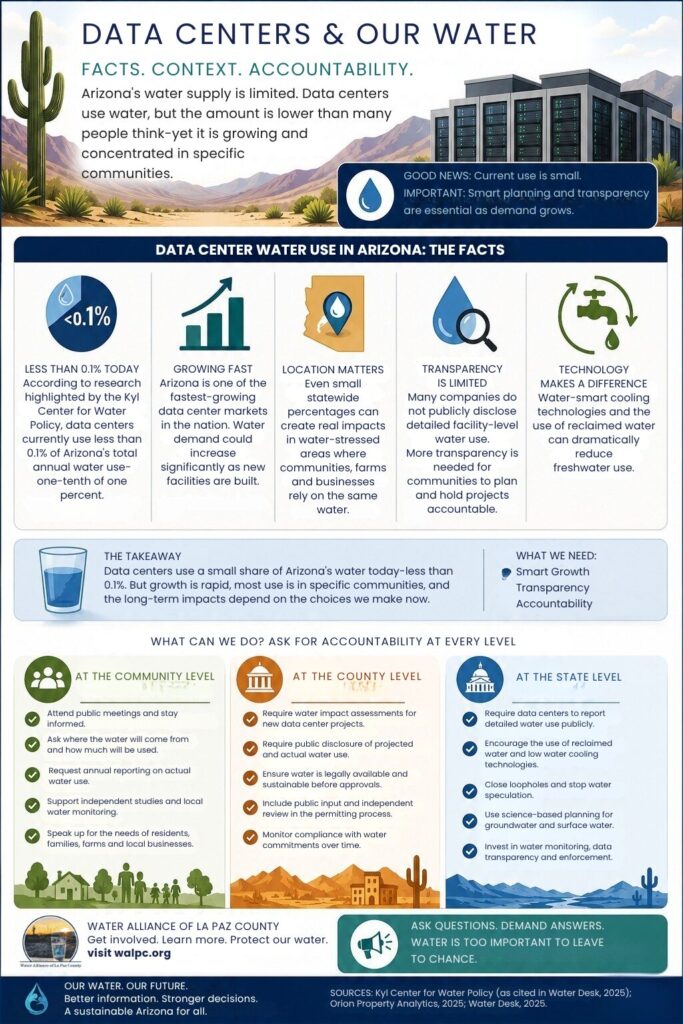
According to research and public discussion from the Kyl Center for Water Policy at Arizona State University, data center water use in Arizona currently represents a relatively small portion of total statewide water consumption compared to sectors such as agriculture (source: https://issuu.com/asuwattscollege/docs/kyl_center_-_industrial_water_use_placeholder)
Agriculture remains by far the largest water user in Arizona. That does not mean concerns about data centers are unfounded. Rather, it means the conversation should focus on scale, location, transparency, and cumulative impacts rather than fear alone.
In some rural areas, even a relatively modest new industrial water demand can become significant when groundwater levels are already declining or infrastructure is limited.
The Bigger Picture: Water and Energy
One of the less discussed aspects of AI infrastructure is that data centers also require enormous amounts of electricity. That means their impact extends beyond direct water use.
Additional energy generation may increase indirect water demand depending on the type of power production involved. Communities must also consider transmission infrastructure, land use, economic tradeoffs, and long-term regional planning.
This is especially important in Arizona, where population growth, prolonged drought, Colorado River shortages, and groundwater depletion are already creating pressure on water systems.
Not All Data Centers Are the Same
Technology companies are increasingly exploring ways to reduce water consumption through:
- Air cooling systems
- Recycled water use
- More efficient cooling technologies
- Renewable energy integration
- Water stewardship programs
Some newer facilities use significantly less water than older designs. Because of this, communities evaluating proposed projects should avoid treating all data centers as identical. Asking detailed questions about technology, water sourcing, conservation measures, and long-term accountability is essential.
Questions Communities Should Ask
When discussing potential industrial or technology development, communities may benefit from asking:
- Where will the water come from?
- Will groundwater be used?
- How much water will be consumed annually?
- What cooling technologies will be used?
- Will recycled or reclaimed water be incorporated?
- How will the project impact local infrastructure?
- What economic benefits will remain local?
- What happens during drought conditions?
- How transparent will reporting and monitoring be?
These questions are part of responsible long-term planning in an arid region.
The Future Will Require Better Conversations
Artificial intelligence and digital infrastructure are likely to continue expanding in the coming years. The question is not simply whether Arizona should allow growth, but how that growth should occur and what safeguards communities expect along the way.
For rural communities, staying informed and engaged will be critical.
Water is not just an environmental issue. In Arizona, it shapes economic development, public health, housing, agriculture, and the long-term future of entire communities.
As conversations around AI and data centers continue evolving, communities deserve clear information, honest dialogue, and a meaningful voice in decisions that may affect their future.
Click on the image below to open the PDF version